A free printable seizure diary. Room for what you remember.
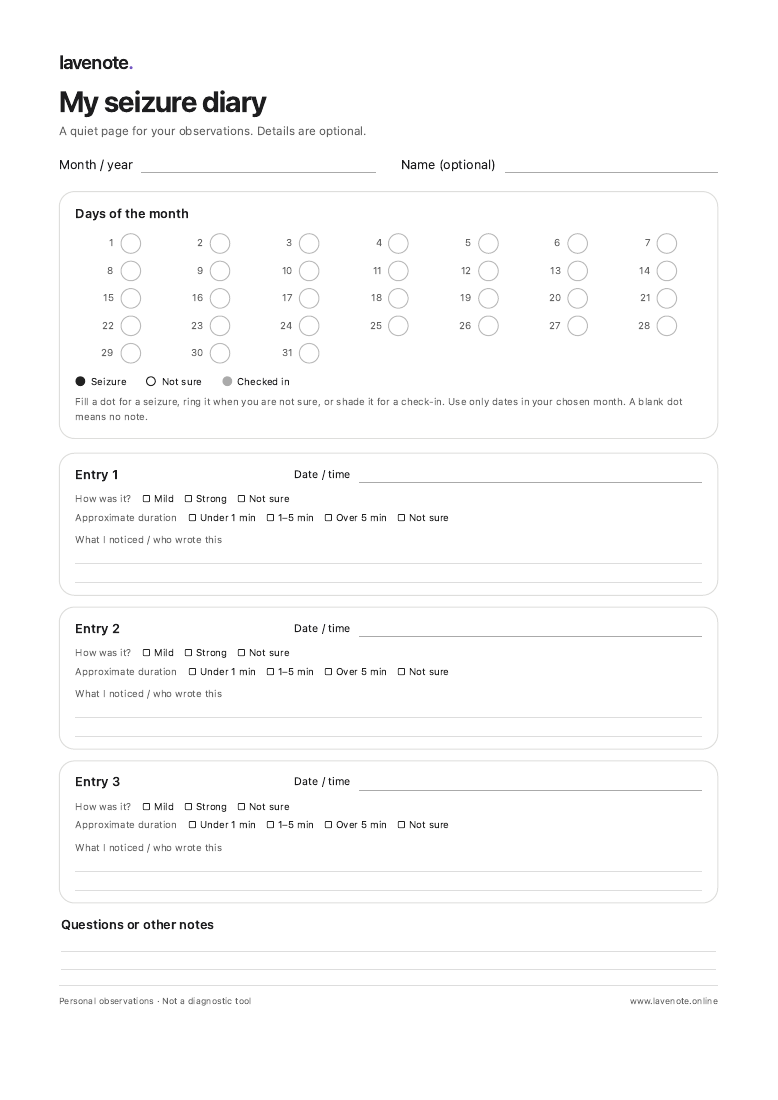
Keep the details you want to remember on one simple page. Open the blank A4 sheet in the viewer, print it and add notes in your own words. You can use it without installing Lavenote.
Print this sheetOne A4 page · Three entries · Month of dots · No email or account required
How to use the printable
- Open the viewer and select “Print this sheet”. Select A4 and your printer’s fit-to-page option if needed. Print another copy when you want more space.
- Add a name or month only if useful. Both fields are optional. Keep completed sheets somewhere you are comfortable storing personal notes.
- Use one space for each entry. Write the date and time if you know them, then any approximate duration you can recall.
- Keep uncertainty visible. Leave a field blank or write “not sure” when you do not know. Use the lines for what you or a witness noticed.
What is on the sheet?
The template has optional name and month fields, three entry cards and a month of dots, and a separate line for questions you want to bring to an appointment.
- Date and time, if known
- A place for an exact time or an honest approximation.
- Approximate duration, if known
- You can leave it blank when you do not know.
- What I or a witness noticed
- Space for your own observations and details you want to remember.
- Other notes or questions
- Something you want to revisit with your healthcare team.
Epilepsy Action’s diary guidance describes keeping a record of timing, duration and what someone noticed before or after an event. This is our original, simplified note-taking layout, not a copy of its diary.
A short example, with uncertainty left in
This example is fictional. It shows how a note can stay incomplete without pretending to be precise.
Date / time: 12 October, around 18:20.
Approximate duration: Not sure.
Observation: My sister wrote down what she saw. I added a few details later.
Question: What would be most useful to write down next time?
The example does not identify a seizure type or establish a cause. Use your own words rather than trying to fit your experience to someone else’s note.
Keep the notes ready for your next conversation
The Epilepsy Foundation’s guide to seizure diaries recommends choosing a format you can use and asking your healthcare team which details matter for your situation. The sheet is a place to keep observations; your team can help you decide what else to include.
Keep your pages in date order if that helps you find them later. Leave space for questions. You do not need to complete every field to keep a useful note.
A few practical questions
Is the PDF free?
Yes. The download opens directly. There is no email form, account or app installation requirement.
Can I type into it?
This version is designed for printing and handwriting. You can add text using a PDF annotation tool, but it is not a fillable web form.
Do I have to write down every detail?
No. The layout leaves room for what you know. Ask your healthcare team which information is useful for you.
Can family help keep the notes?
The sheet has room for observations from a witness. Make clear who added a note, and choose who you want to share the completed page with.
Original template and guide by Lavenote. This resource is for keeping personal observations, not diagnosis or treatment. Independent sources are linked where discussed; they do not endorse Lavenote.
All diary resources ↗